This release comprises two different realisations of Golden Sunset, Blue Rain, each just over half an hour in duration: ‘Lower World, Parts 1-10’ (tracks 1-10) and ‘Sky Cry, Parts 1-10’ (tracks 11-20). In ‘Lower World, Parts 1-10’, additional field recordings are introduced into the piece, including the sounds of walking through Delamere Forest, Cheshire and walking over rocks in Lud’s Church, Staffordshire. Multi-tracked melodicas and additional digital signal processing effects augment the existing Golden Sunset, Blue Rain sound world. In ‘Sky Cry, Parts 1-10’, the vocal chanting is time-stretched and sent through spectral filter delays. Additional vocals are included, along with the powerful sound of a thunderstorm, the melancholic sound of an Irish low D whistle and the meditative sounds of a rain stick and a shruti box.
Number of tracks: 20
Duration: 63’36”
[Nicholas Peters – ‘Spiritual Musicker’, performer (Tibetan singing bowl, Scottish tin whistles, Irish low D whistle, vocals, shruti box, field recordings, egg shaker, wooden frog percussion, rain stick, live digital signal processing), mixing and mastering]
Golden Sunset, Blue Rain, Volume 4 by Nicholas Peters (2020)
Clickhereto listen to Golden Sunset, Blue Rain, Volume 4 on your preferred music service.
This release comprises two different realisations of Golden Sunset, Blue Rain, ‘Flight, Parts 1-11’ (tracks 1-11) and ‘Worlds Apart’ (track 12). In ‘Flight, Parts 1-11’, the listener is introduced to the sound world of Golden Sunset, Blue Rain through the use of handheld percussion (egg shaker, wooden frog and Tibetan singing bowl) layered with multitracked Scottish tin whistles. The tin whistles are pitch shifted, along with the vocal chanting. Field recordings of birdsong are introduced into the soundscape, connecting the listener to nature and Mother Earth. In ‘Worlds Apart’, the soundscape is condensed into an 11.5 minute shamanic soundscape journey. Here, additional types of digital processing are used in the mix, including a pitch drop effects and different types of delay systems from the earlier realisations of the work.
Number of tracks: 12
Duration: 53’52”
[Nicholas Peters – ‘Spiritual Musicker’, performer (Tibetan singing bowl, Scottish tin whistles, vocals, egg shaker, wooden frog percussion, field recordings, live digital signal processing), mixing and mastering]
Golden Sunset, Blue Rain, Volume 3 by Nicholas Peters (2020)
Clickhereto listen to Golden Sunset, Blue Rain, Volume 3 on your preferred music service.
This release comprises one continuous realisation of Golden Sunset, Blue Rain, ‘Upper World, Parts 1-8’ (tracks 1-8). This realisation places the focus on the serenity of the continuous tones produced from a multitracked Tibetan singing bowl combined with Scottish tin whistles.
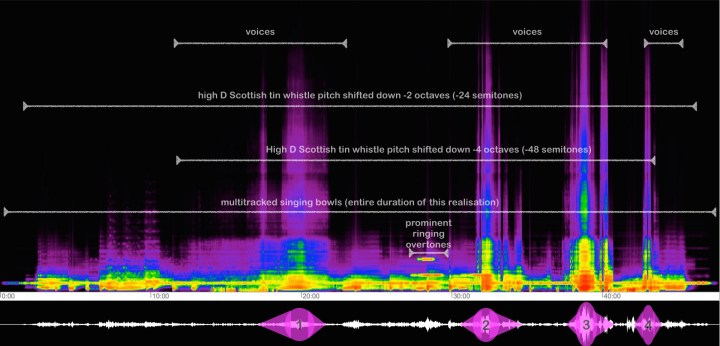
The image below shows a macro structural analysis of ‘Upper World, Parts 1-8’ on a linear scaled sonogram. The rainbow sonogram in the image below shows the frequency response with the highest frequencies in purple and the lowest frequencies in red. It should be noted though, that the names of the instruments do not appear in this image in relation to their frequency responses, rather they simply show their prominence within the overall macro structure of this realisation of the work. The waveform below the sonogram marks the four main textural and dynamic build-ups marked numerically in magenta circles, along with their respective crescendi/diminuendi.
Golden Sunset, Blue Rain, Volume 2: ‘Upper Worlds, Parts 1-8’ macro structure.
As with Volumes 1, 3 and 4, Nicholas Peters performs all of the instruments, vocals and digital treatments in this album release.
Number of tracks: 8
Duration: 47’51”
[Nicholas Peters – ‘Spiritual Musicker’, performer (Tibetan singing bowl, Scottish tin whistles, vocals, live digital signal processing), mixing and mastering]
Golden Sunset, Blue Rain, Volume 2 by Nicholas Peters (2020)
Click here to listen to Golden Sunset, Blue Rain, Volume 2 on your preferred music service.
This release comprises three different realisations of Golden Sunset, Blue Rain, ‘Summoning the Ancestors, Part 1-4 (tracks 1-4), ‘The Power Song of the Shaman’ (track 5), and ‘Wakan Tanka, Parts 1-5’ (tracks 6-10). The three recordings on this album are the earliest realisations of Golden Sunset, Blue Rain. ‘The Power Song of the Shaman’ is the oldest of the three realisations on this release and it was composed for Scottish tin whistles, vocals and digital delays and reverbs. ‘Summoning the Ancestors, Parts 1-4’ and ‘Wakan Tanka, Parts 1-5’ are for vocals and digital delays and reverbs.
Number of tracks: 10
Duration: 48’40”
[Nicholas Peters – ‘Spiritual Musicker’, performer (vocals, Scottish tin whistles, live digital signal processing), mixing and mastering]
Golden Sunset, Blue Rain, Volume 1 by Nicholas Peters (2020)
Clickhereto listen to Golden Sunset, Blue Rain, Volume 1 on your preferred music service.
‘Invocation of the Spirits’ [EP] is a spiritual soundscape combining the sounds of rhythmic hurdy-gurdy drones paired with thundering bass drums, bell tower, vocals and synthesizers.
Release date: 12th June 2020
Number of tracks: 1
Duration: 14’11”
Track List [track duration in minutes and seconds]. The link will take you through to the track onSpotify.
‘The Clouds Will Pass’ [EP] was composed during the nationwide COVID-19 pandemic lockdown. This composition developed around a piano improvisation sent through digital delay systems. Each additional instrumental/vocal part was then overlaid using multitracking techniques.
Release date: 1st June 2020
Number of tracks: 1
Duration: 11’17”
Track List [track duration in minutes and seconds]. The link will take you through to the track onSpotify.
‘Sunflower Serenade’ [single] was composed during the nationwide COVID-19 pandemic lockdown. I composed the piece as a light reflective composition, suitable for grounding and meditation purposes, especially in SEND settings. I released two versions of the piece; track 1 is the light orchestral arrangement, and track 2 is the solo electric piano version. The orchestral version of ‘Sunflower Serenade’ was subsequently used as the score for the independent short film The Youth of Nature, directed by Cameron Moon (2021).
Release date: 22nd May 2020.
Number of tracks: 2
Duration: 06’09”
Track List [track durations in minutes and seconds]. The links will take you through to the track onSpotify.
The Mahamrityunjaya Mantra is an ancient Sanskrit healing mantra by Sage Markandeya to Shiva. This mantra is so powerful that, for the divine chanter, it is said to defeat death and disease:
Om Trayum-bakam Yajamahe Sughan-dhim Pushti Vardanam
Urvar-Ukamiva Bandhanan Mrityor Mukshiya Mamritat
In this recording, the mantra is chanted 108 times, accompanied by underscoring electronic drones which play the pedal notes ‘E’ and ‘B’ to provide an open fifth tonality.
Mahamrityunjaya Mantra (108 Times) by Nicholas Peters (2020)
Spiritus Spatium is an album of ambient-space-drone music I composed, mixed and mastered in October 2019. Translating approximately as ‘Spirit Space’, Spiritus Spatium is a 62-minute electronic composition divided into 12 sections (tracks) that play as a gapless album. The musical material for Spiritus Spatium is based around a continuous drone in octaves on the note ‘A’ and with an added fifth (‘E’), played by a layering of synthesizers and processed strings which gradually pulse, creating a swell-release effect throughout the composition. The other sounds heard in Spiritus Spatium are processed handbells, a processed (modular) piano and a processed choir pad.
The sonic events for the entire composition were determined by using an ISBN-13 (*) across 13 separate MIDI tracks. Each MIDI track plays the ISBN-13 sequence through in its entirety, but each MIDI starts and finishes on a different number (note) in the sequence. The pitch played is determined by the number relative to the note in the A Aeolian scale:
1=A 2=B, 3=C, 4=D, 5=E, 6=F, 7=G, 8=A (sounding a perfect octave higher than 1=A), 9=B (sounding a perfect octave higher than 2=B), 0=silence.
The distance between one note sounding and the next on each track is similarly determined by the ISBN-13; lower numbers have shorter distances than the higher numbers in the sequence. All of the sounds applied to the MIDI tracks were programmed to have very long attack and release times to allow the sounds to enter the soundworld smoothly, and to swell and fade very gradually. A convolution reverb and delay effects were used to further create a deep space aesthetic.
All of the sounds used in Spiritus Spatium are from Spitfire Audio LABS virtual instruments, which are free for composers to download and use in their commercial projects.
Release date: 18th November 2019
Number of tracks: 12
Duration: 62’03”
Track List [durations in minutes and seconds]. The links will take you through to the corresponding track onSpotify.
‘A Little Noise in the WASP’ was composed in December 2009, and released as a single on the download and streaming services in November 2019.
‘A Little Noise in the WASP’ is a 10-minute exploration of the soundworlds created by multi-tracking the sounds produced from the legendary Electronic Dream Plant (EDP) WASP synthesizer. The sounds are sent through a series of digital delay systems to create dense layers, varying from a white noise ‘snare’, through to piercing sine wave tones and deep bass. The piece sits comfortably within the category of ‘uneasy listening’ and electronic, experimental, drone, noise music.
Number of tracks: 1
Duration: 09’54”
Track List [duration in minutes and seconds]. The link will take you through to the track on Spotify.
Axis Mundi by Nicholas Peters (2008, released in 2019) [album artwork]
Axis Mundi was composed in 2008 and it was remastered and released for streaming and download in June 2019.
Axis Mundi is a 40-minute shamanic soundscape, released as a single-track album. The album features a range of instruments, including African knee drum, bass clarinet, didgeridoo, handheld percussion, wineglasses, synthesizers, Theremin, and voices. The album features several guest performers:
Mark Andrew Summers – bass clarinet
Katherine Ann Jewkes – voice
Kaytlyn Reese – voice
Release date: 14th June 2019
Number of tracks: 1
Duration: 40’12”
Track List [track duration in minutes and seconds]. The link will take you through to the track onSpotify.
As a soundscape, Axis Mundi flows in a laminar fashion, taking the listener gradually from one soundworld into the next using slow crossfading techniques (fade-in/fade-outs) that last several minutes each.
The title of the work, Axis Mundi, refers to the spiritual place of power used by shamans and shamanic practitioners the world over to undertake shamanic journeying. The Axis Mundi is sometimes referred to as the Cosmic Tree, or the World Tree; it is the place that connects the realms of ‘ordinary’ and ‘nonordinary’ realities together.
Click here to listen to Axis Mundi on your preferred music streaming service.
Axis Mundi by Nicholas Peters (2008, released in 2019)
flockOmania Finale (2015) filmed and edited by George Rippon. flockOmania, was a solo exhibition created by jewellery artist Zoe Robertson, culminating in a multi-disciplinary event which took place at Coventry University, Coventry, in February 2015. The music and sound for the event (and in the video above) was performed by Nicholas Peters and Daren Pickles.
The following artists were involved in flockOmania Finale (2015):
Incidental music, sound effects and live vocal processing by Nicholas Peters.
Doctor Faustus – Act One
Doctor Faustus (written by Christopher Marlowe) directed by Joff Chafer, performed by Year 2 Theatre and Professional Practice students, Coventry University, Coventry, December 2014. Incidental music, sound effects and vocal processing by Nicholas Peters. Video by Tom Gorman.
Doctor Faustus – Act Two
Doctor Faustus (written by Christopher Marlowe) directed by Joff Chafer, performed by Year 2 Theatre and Professional Practice students, Coventry University, Coventry, December 2014. Incidental music, sound effects and vocal processing by Nicholas Peters. Video by Tom Gorman.
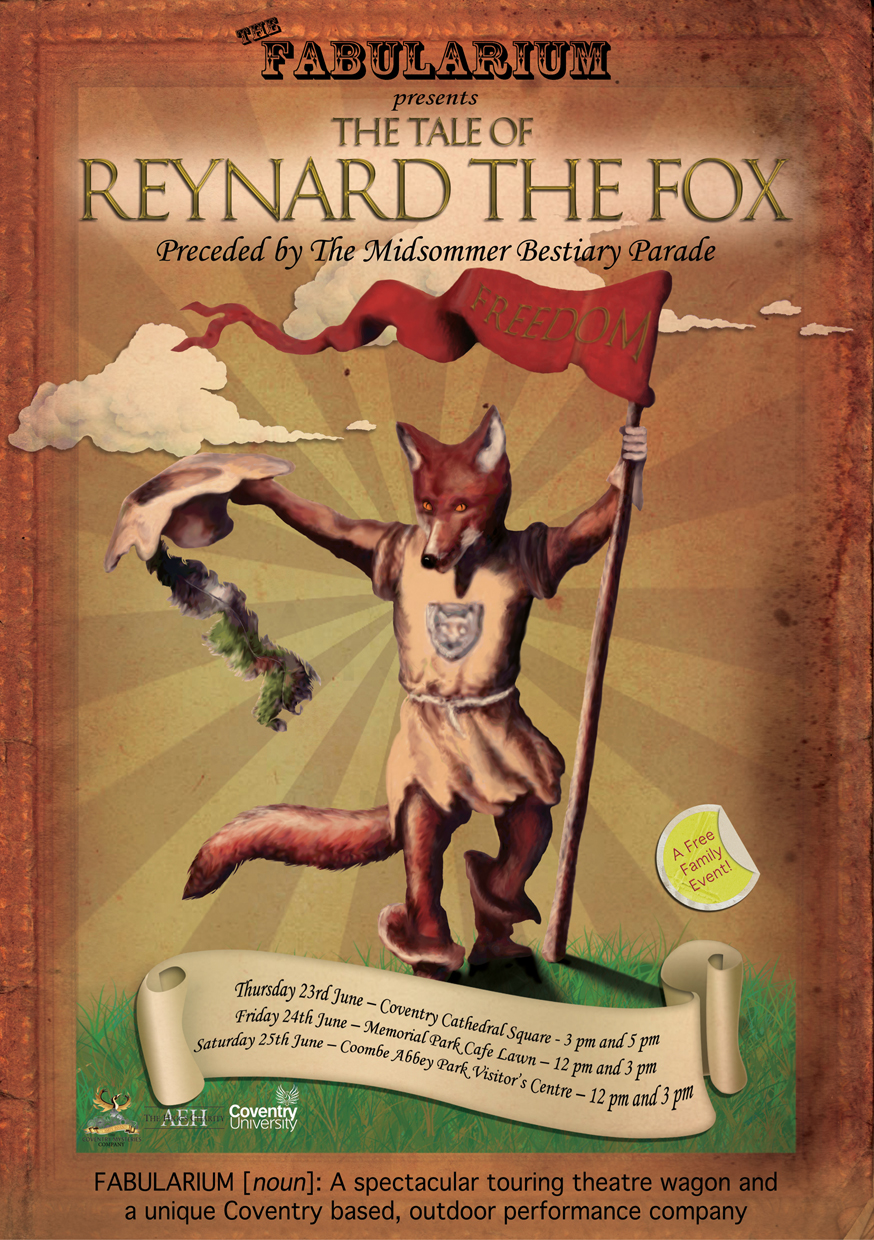
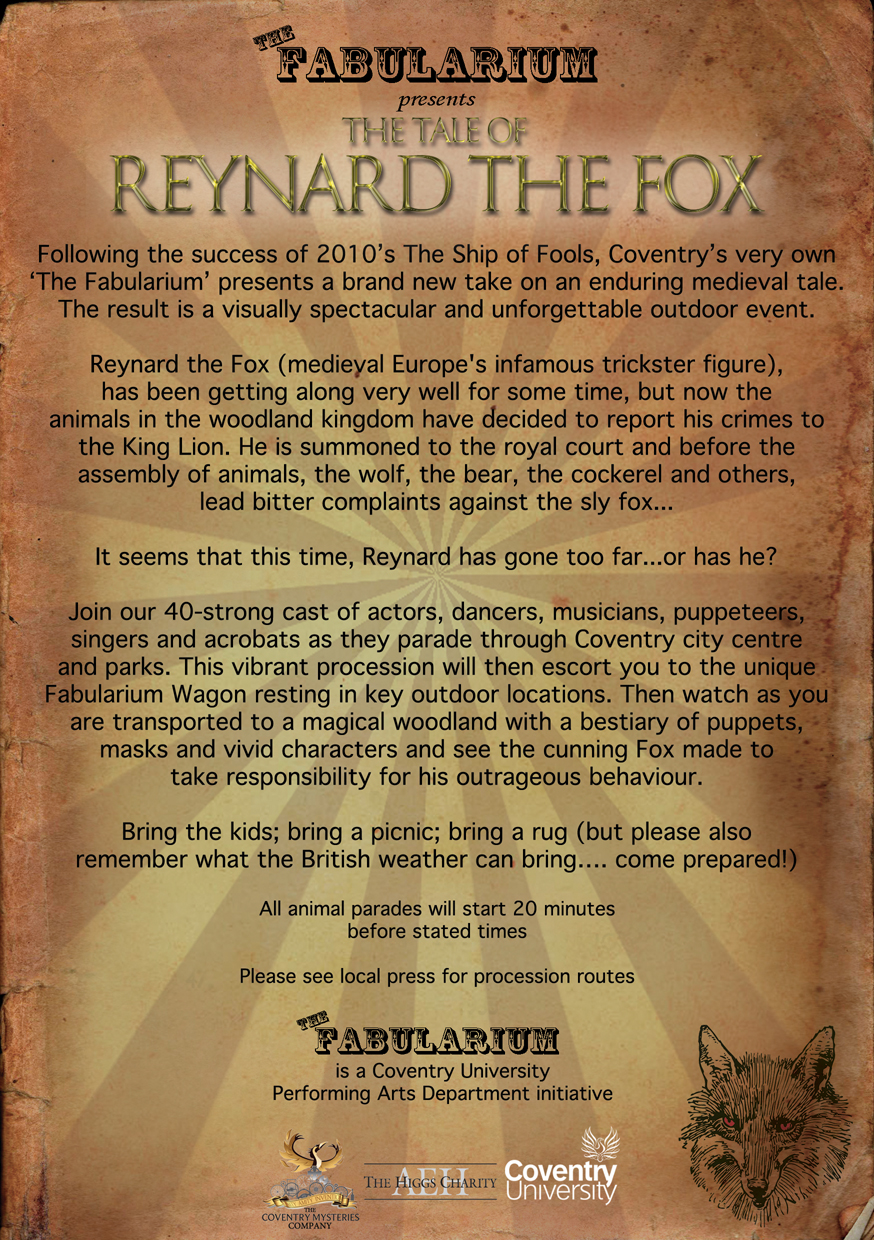
The Fabularium: The Tale of Reynard the Fox performance flyer (2011)
In May-June 2011, I worked for The Fabularium as the music director for an outdoor theatrical touring performance of The Tale of Reynard the Fox. The company toured three locations in Coventry, Coventry Cathedral Square, Memorial Park Cafe Lawn and Coombe Abbey Visitor’s Centre. I was responsible for rehearsing the ensemble cast singing, as well as directing the group of musicians for the animal procession and the underscoring live incidental cèilidh music.
The fabulous Fabularium project director was Glenn Noble.
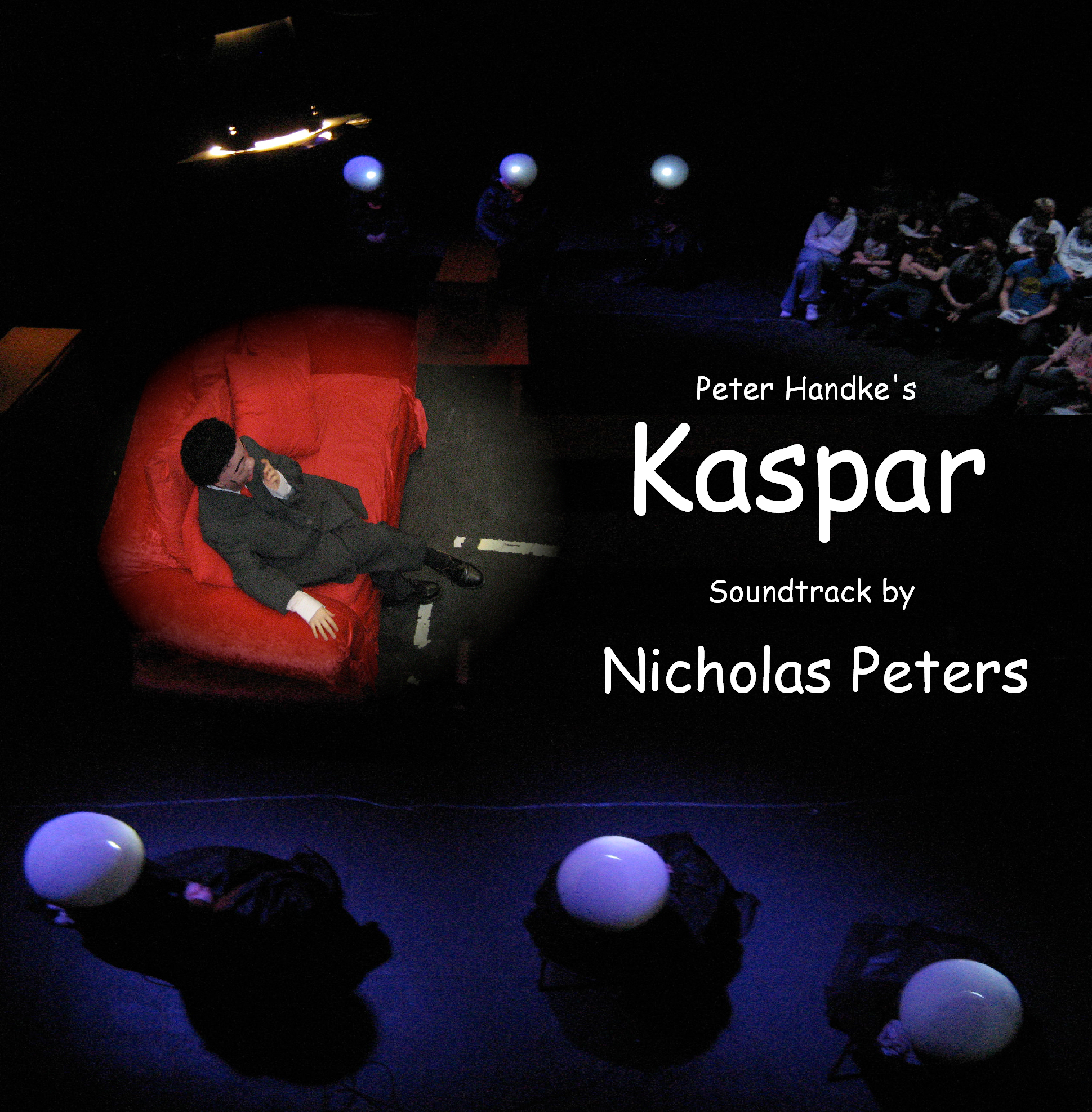
Kaspar (written by Peter Handke in 1967), directed by Tom Gorman, performed by Second Year BA Theatre and Professional Practice students, Coventry University. Music by Nicholas Peters.
Peter Handke’s abstract play Kaspar (1967) explores the theme of speech torture as the main character interacts with the world through everyday physical objects and nonsense speech.
Performed by Year 2 BA Theatre and Professional Practice students, Coventry University, Coventry in December 2008.
Total duration of soundtrack: 2 hours, 55 minutes, 1 second.
Music by Nicholas Peters.
Soundtrack Overview
The soundtrack is characterised through the use of long, resonant, piercing tones and slowly shifting drones, produced by manipulating and layering the sounds produced from a ringing wineglass and a wobbly Theremin.
The laminar soundscape of the wineglass and the Theremin were enhanced by recording human and computer-generated vocals. These vocals were processed to sound artificial, with ring modulation and pitch-shifting effects.
A metronome was recorded ticking at a slow tempo and this was faded in and out of the soundtrack over a long duration. When coupled with the screeching wineglass, the hypnotic tones of the Theremin and the manipulated voices, the soundworld for Kaspar was brought to the ears of the audience.
![Golden Sunset, Blue Rain, Volume 4 by Nicholas Peters [Album] Artwork](https://nicholaspeters.co.uk/wp-content/uploads/2020/10/golden-sunset-blue-rain-volume-4-artwork-3000.jpeg)
![Golden Sunset, Blue Rain, Volume 3 by Nicholas Peters [Album] Artwork](https://nicholaspeters.co.uk/wp-content/uploads/2020/10/golden-sunset-blue-rain-volume-3-artwork-3000.jpg)
![Golden Sunset, Blue Rain, Volume 2 by Nicholas Peters [Album] Artwork](https://nicholaspeters.co.uk/wp-content/uploads/2020/10/golden-sunset-blue-rain-volume-2-artwork-3000.jpg)
![Golden Sunset, Blue Rain, Volume 1 by Nicholas Peters [Album] Artwork](https://nicholaspeters.co.uk/wp-content/uploads/2020/10/golden-sunset-blue-rain-volume-1-artwork-3000.jpg)
![Invocation of the Spirits by Nicholas Peters [EP] Artwork](https://nicholaspeters.co.uk/wp-content/uploads/2020/10/invocation-of-the-spirits-artwork-v2.jpg)
![The Clouds Will Pass by Nicholas Peters [EP] Artwork](https://nicholaspeters.co.uk/wp-content/uploads/2020/10/the-clouds-will-pass-artwork.jpg)
![Sunflower Serenade by Nicholas Peters [Single] Artwork](https://nicholaspeters.co.uk/wp-content/uploads/2020/10/sunflower-serenade-artwork-v1.jpg)
![Mahamrityunjaya Mantra (108 Times) by Nicholas Peters [Album] Artwork](https://nicholaspeters.co.uk/wp-content/uploads/2020/10/mahamrityunjaya-mantra-artwork.jpg)
![Hope Still Shines For You by Nicholas Peters [Single] Artwork](https://nicholaspeters.co.uk/wp-content/uploads/2020/10/hope-still-shines-for-you-artwork.jpg)
![Spiritus Spatium by Nicholas Peters [Album] Artwork.](https://nicholaspeters.co.uk/wp-content/uploads/2020/10/spiritus-spatium-v1.jpg)
![A Little Noise in the WASP by Nicholas Peters [Single] Artwork.](https://nicholaspeters.co.uk/wp-content/uploads/2020/10/a-little-noise-in-the-wasp.jpg)
![Axis Mundi by Nicholas Peters [Album] Artwork](https://nicholaspeters.co.uk/wp-content/uploads/2020/10/axis-mundi-album-artwork.jpeg)

 Nicholas Peters
You must be logged in to post a comment.